
Written by Michael Adu-Brew, Jillian Stewart, Michael Zhao, and Niranjana Krishnan.
My students/staff and I co-wrote this piece back in January 2025, soon after the U.S. Fish and Wildlife Service had proposed to list the monarch butterflies under the Endangered Species Act. We wrote this for a Spanish extension website, and you can find that version here: https://extensionesp.umd.edu/2025/02/21/el-futuro-de-las-mariposas-monarca/. The English version, copied below, can also be found on our extension website: https://www.mdpsep.com/open-access-resources
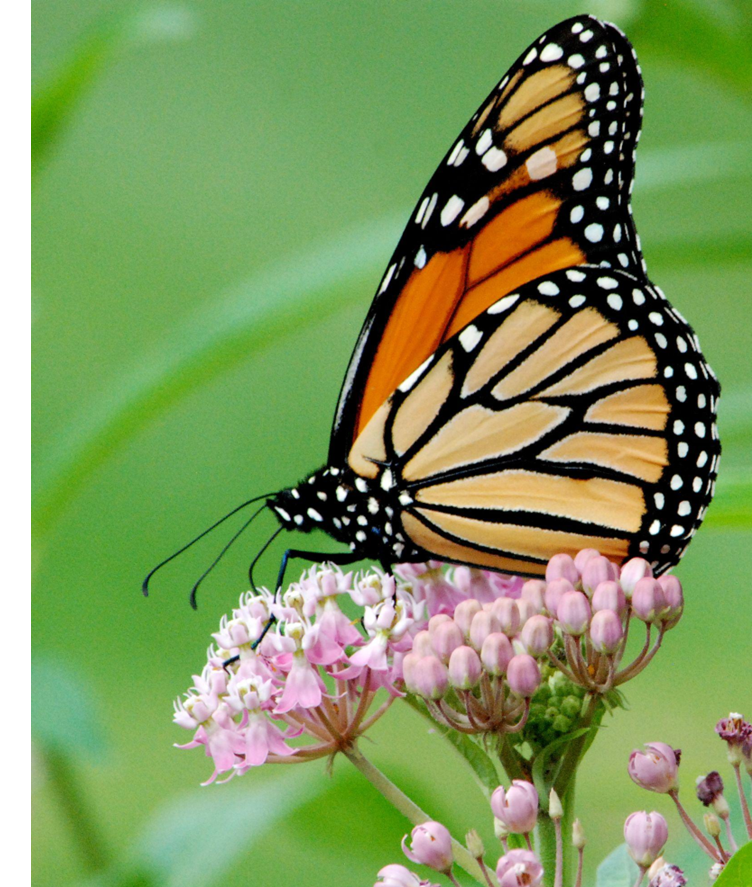
As the seasons change, it is not unusual to see droves of the iconic orange and black monarch butterfly migrate through the sky. Millions of these stunning butterflies make their journey from central Mexico and California to the southern edge of Canada—encompassing nearly the entirety of the United States. Monarch butterflies are a well-loved species in North America and play several important roles. They help pollinate plants, can be good indicators of environmental health, and are used to educate the public about insects and develop curiosity towards the natural world. The monarch also has cultural significance; their imagery is often used in Día de Muertos (Day of the Dead) celebrations and, because of their striking coloration and enigmatic migration, they motivate people to protect other species and the environment.


Despite incredible images of migrations with hundreds of thousands of individuals, monarch butterfly populations have been in decline for decades. The population east of the Rocky Mountains has suffered an 80% decline while the population west of it has suffered a 95% decline. The declines can be attributed to multiple factors, including loss and degradation of milkweed—the obligate host plant—and overwintering habitat, exposure to pesticides, and climate change. In 2013-14, the lowest monarch migration numbers were recorded; this resulted in a petition being submitted to the U.S. Fish and Wildlife Service (USFWS) to list the monarch butterfly under the Endangered Species Act.
The Endangered Species Act—signed into law in 1973—is a landmark piece of legislation in the United States whose purpose is to prevent the extinction of species, help species recover their populations, and maintain diversity in the ecosystem. It does this by providing a framework to list species as endangered or threatened, preventing the sale, transport, or activities involving these species, requiring federal agencies to protect them, and promoting international conservation.
Monarch butterfly proposed listing decision
In 2020, the USFWS declared that the monarch butterfly warranted protection under the Endangered Species Act but waitlisted it for more at-risk species. In December 2024, an official proposal was released to list the monarch butterfly population as a threatened species and designate some of the western population’s overwintering grounds in California as critical habitat (i.e., area necessary for conservation of listed species). In addition to this, a 4(d) ruling has also been proposed which allows the USFWS to customize prohibitions for threatened species.
For the monarchs, the USFWS has proposed to prohibit the following activities in the contiguous United States, Puerto Rico, and the U.S. Virgin Islands: import or export of monarch butterflies; take (i.e., harming, pursuing, hunting, wounding, killing, trapping, capturing, or collecting, or attempting to engage in any such conduct); possession, delivery, receiving, carrying, transporting, shipping, selling or offering for sale in interstate or foreign commerce. However, permits may be issued to carry out specific activities for scientific purposes, educational purposes, economic hardship, zoological exhibition, incidental take, or actions that enhance the propagation or survival of monarch butterflies.
The USFWS is also proposing to exempt certain activities from take as these will aid in the direct conservation and recovery of monarchs, are unlikely to negatively affect monarch populations, and/or provide lifelong connections to nature and inspirational and educational value to the public. These include:
- Activities (e.g., habitat restoration and management, livestock grazing and routine ranching activities, routine agricultural activities, vegetative management activities, fire management actions, etc.) that may maintain, enhance, remove, or establish milkweed and nectar plants within the breeding and migratory range. However, these activities should not result in conversion of native or naturalized grassland, shrubland, or forested habitats.
- Implementation of comprehensive conservation plans and programs for the monarch butterfly. These plans should address threats to monarchs within the plan area, establish objective measurable goals for population and habitat, include appropriate monitoring of effectiveness and compliance, etc.
- Maintenance or improvement of overwintering habitat in California, if it is consistent with site-specific USFWS-approved overwintering site land management plan.
- Vehicular strikes as it is common for monarchs to be struck by vehicles and killed during normal driving activities.
- Non-lethal collection, possession, captive-rearing, and release of 250 or fewer monarchs at one location (e.g., home, botanical garden, school, business) per year. Collection of any clustering monarchs at overwintering sites is prohibited.
- Non-lethal scientific research and educational activities (handling, netting, sampling for disease, tagging, and conducting life cycle and specimen observations of captive monarchs) involving 250 or fewer monarchs at one location per year. Collection of any clustering monarchs at overwintering sites is prohibited.
- Sale of 250 or fewer captively reared monarchs per year from a single location or facility.
- Collection and possession of dead monarchs as it is common to find dead adult monarchs or pieces of wings. Collection of live wild adult monarchs and intentionally killing them for preservation purposes is prohibited.
What information is the USFWS looking for?
The USFWS lacks adequate information on certain topics and therefore encourages public comments. Primarily, they want input on how to address pesticide use under a 4(d) rule for monarch butterflies. As not all pesticides will impact monarchs directly or indirectly, the USFWS is seeking information on which pesticide uses and application methods would cause adverse impacts to monarchs, whether to exempt certain pesticide uses from take, and whether those exemptions should include measures to mitigate pesticide effects. They are also seeking comments on whether to tailor measures to areas and times of the year when monarchs are present, feasible ways to convey measures to pesticide users, and whether habitat restoration can serve as an offset for unavoidable pesticide impacts under the 4(d) rule.
Additionally, the USFWS is looking for more information on monarch’s biology, range, and population trends, conservation actions and other threats affecting them, their historical and current status, application or issuance of protective regulations under the 4(d) rule, management of critical habitat, etc. Public comments are due on March 12, 2025, at 11:59 PM EDT. They can be submitted electronically at regulations.gov or by mail to
Public Comments ProcessingAttn: FWS-R3-ES-2024-0137
U.S. Fish and Wildlife Service, MS: PRB/3W
5275 Leesburg Pike, Falls Church, VA 22041-3803
The USFWS will respond to the public comments and make a final listing decision for the monarchs (and describe associated restrictions, if any) in December 2025.
What can you do?
Excluding catastrophic events, the eastern population has a probability of extinction of less than 10% in 10 years while the western population has a probability of extinction of 60-68% in 10 years. Thus, apart from submitting public comments, there are several things you can do to help monarch populations. These include:
- Creation, enhancement, and maintenance of habitat (milkweed and nectar plants) in monarch breeding and migratory areas;
- Protection and enhancement of monarch overwintering areas;
- Avoidance and minimization of pesticide exposure to monarchs and milkweed;
- Continued public support for monarch conservation.
If the species is listed, funding for recovery actions will be available from multiple sources, including through federal and state programs and cost-share grants.
 EnTox Simplified